

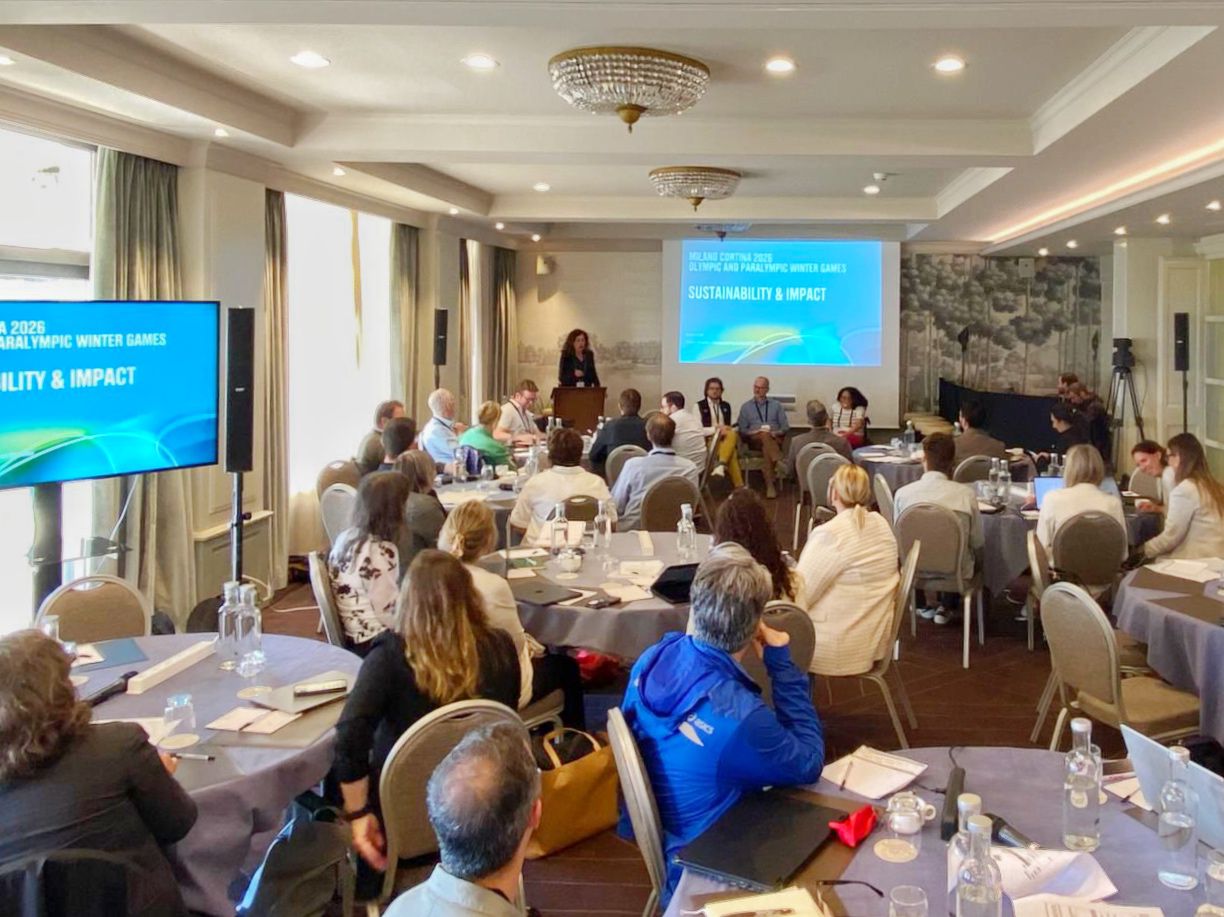
Representatives from more than 30 Summer Olympic International Federations (IFs) gathered this week for the ASOIF Sustainability Workshop, addressing key challenges such as delivering major sporting events in the context of climate risk, advancing sustainable finance, strengthening accountability frameworks for event organisers, mapping procurement practices, integrating sustainability into sponsorship agreements, and promoting environmentally responsible sports venues.
Addressing the impact of climate change on major sporting events
Held on 21-22 April in Lausanne, Switzerland, the two-day workshop - organised by the ASOIF Sustainability Commission (ASC) - combined expert-led panel discussions with interactive breakout sessions. This format enabled the 66 participants to exchange insights and collaborate on sustainability challenges most relevant to their organisations.
The workshop opened with a captivating keynote address by Daniel Kull, Director of Development Partnerships and Programme Delivery at the World Meteorological Organization (WMO), who highlighted how climate risk and sustainable finance are reshaping the delivery, insurability, and resilience of major sporting events.
Additional contributions came from leading experts across the Olympic Movement and beyond, including the IOC’s Head of Sustainability Julie Duffus, Fondazione Milano Cortina 2026’s Sustainability and Impact Director Gloria Zavatta, the IOC’s Senior Category Manager Julie Guivarch, On Running’s Senior Lead for Sustainability Intelligence Roman Bolli, and Swiss Olympic’s Spatial and Environmental specialist Laura Schreurs.
Focus on action paired with a shared sense of purpose
David Graham, Chair of ASOIF’s Sustainability Commission and Chief Executive Officer of World Sailing, reflected on the outcomes of the workshop:
“The convergence of leading sustainability experts, 35 Olympic sports, and a shared determination to collaborate created a uniquely powerful forum. The result was content rich discussions that culminated in practical, action-focused outcomes and a clear sense of collective purpose.”
Discussions underscored the importance of aligning approaches across IFs and highlighted the collective responsibility of the Olympic Movement to maximise sport’s contribution to sustainability. In doing so, participants reinforced their commitment to supporting the United Nations Sustainable Development Goals.
Key outcomes and takeaways
Concrete outcomes and takeaways from the workshop include:
a commitment to amplify climate-related messaging across a wider audience, such as sharing the highly relevant WMO keynote speech with the athlete community;
the provision of the SMART platform - a digital, data-driven tool created jointly by the IOC and ASOIF that helps IFs measure, assess, and improve sustainability performance - by October 2026 (IF Forum);
identification of priority areas for further development, including the reduction and compensation of carbon emissions, implementation of sustainability standards by Local Organising Committees, development of practical toolkits for event organisers, and exploration of common international standards across IFs;
strengthening approaches to responsible procurement across IF operations and events;
recognition of the need to enhance collaboration between sustainability and commercial functions, including potential future engagement with sponsors across IFs; and
increased focus on the promotion of sustainable infrastructure, particularly improving multi-use and long-term utilisation of venues.
This annual workshop continues to provide a valuable platform for collaboration, knowledge sharing, and capacity building. It is fully aligned with the third strategic pillar of the ASOIF Strategy 2026–2032, which focuses, among other priorities, on developing and modernising platforms for shared learning.