

The Association of Summer Olympic International Federations (ASOIF) today published the results of the Sixth Review of International Federation Governance, which demonstrate continuous improvements by its members across important areas such as gender equality, safeguarding, election campaigning rules, whistleblowing procedures and open procurement. All 31 International Federations (IFs) that participated in 2023-24 once again exceeded the target score of 150 out of 240. Among the five new Associate Members taking part for the first time, four out of five exceeded the target of 135.
The aim of the project, led by ASOIF's Governance Task Force (GTF), is to promote and ensure a culture of good governance within the Summer Olympic IFs, ensure they are fit for purpose now and in the future, and help drive continuous progress.
Snežana Samardžić-Marković, GTF Chair and former Director General of Democracy at the Council of Europe, said: “In a world of geopolitical instability and low-trust environments, strong internal governance - which is credible, transparent and trustworthy - becomes a competitive advantage. Ultimately, the decisive question for 2026 and beyond is not whether global instability will continue, but how IFs are prepared to operate within it. Investing in good governance is a way of shield-building to be ready for the future - it is great to see that many of the ASOIF member federations have embraced this approach.”
ASOIF President Ingmar De Vos said: “Upholding high IF governance standards is an important element of ASOIF’s Strategy 2026-2032 and absolutely essential for defending IFs’ autonomy, enabling them to fulfil their vital role in the complex international world of sport. I would like to thank our member federations for their commitment to this important project, which can be challenging given the multiple competing priorities and responsibilities they face.”
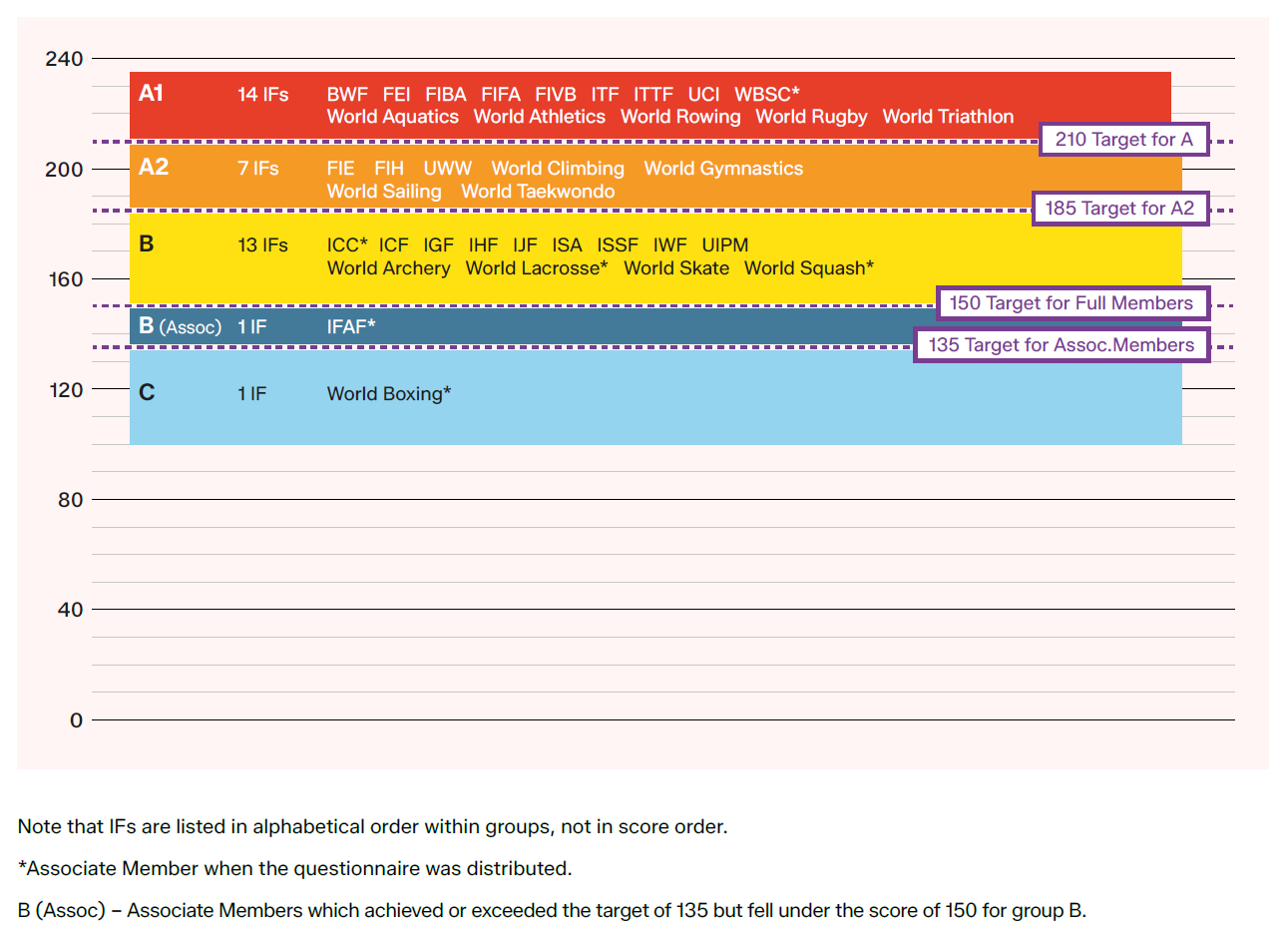
The sports governance consultancy, I Trust Sport, once again independently reviewed the responses and moderated the scores, with each indicator being assessed on a scale of 0 to 4. The number of indicators remained unchanged at 60 from the previous review, with only a few minor amendments introduced for 2025-26. For the fourth consecutive review, IFs were showcased into groups based on their total score (listed in alphabetical order).
Key findings include:
Total moderated scores among the 36 participating Full (30) and Associate (6) Members ranged from 117 to 228 out of 240.
The 31 IFs that participated in the previous review in 2023-24 saw an average increase in their total score of just over 10 points, from approximately 189 to 200.
All IFs that were in the A1 group in 2023-24 retained their status and were joined by seven additional IFs, bringing the total at that level to 14.
All 36 IFs had published at least one year of financial accounts, and 35 had an expenses policy.
An increased number of IFs demonstrated evidence of open tenders, with 22 out of 31 IFs having conducted multiple open tenders in recent years, up from 16 IFs in 2023-24.
There have been further improvements in gender balance at Board level. Of the 31 IFs that participated in 2023-24, nine now have at least 40% female representation on their Boards, up from four in the previous review. Sixteen of the 31 have between 25% and 40% female representation on their Boards.
Thirty-two out of 36 IFs have term limits in place, including the five new Associate Members.
Campaigning rules for elections have been strengthened in several cases, with 15 out of 31 IFs now having regulations in place requiring the disclosure of financial information, compared to seven in 2023-24. Only three IFs did not provide specific information on campaigning rules.
Twenty-four IFs have a confidential reporting mechanism in place, compared to only 15 in 2023-24.
On the topic of safeguarding, 29 out of the 31 IFs that participated in the previous review have a policy in place that is being implemented through training, the appointment of safeguarding officers at events, and the handling of disciplinary cases – an increase from 27 in 2023-24.
Click here to discover more and read the full report.